

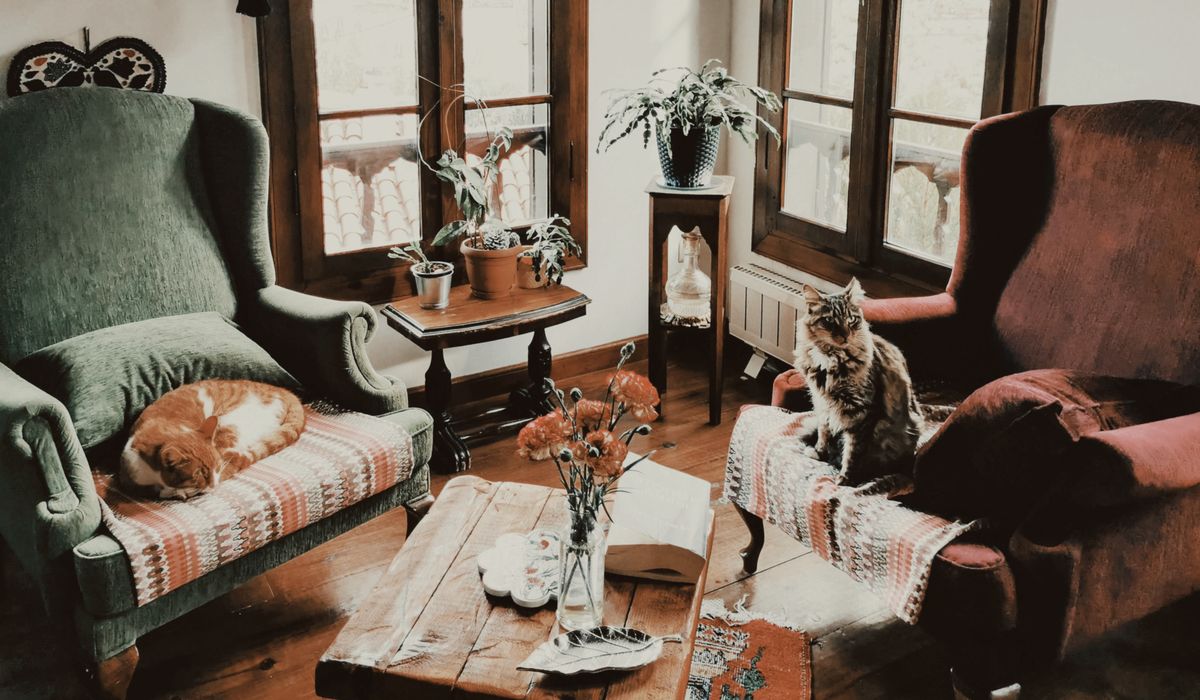
Start with one piece that earns its place
The most common mistake when mixing old and new is treating antiques as decoration. A Victorian nursing chair tucked into a corner, a battered trunk used as a plant stand, a set of china nobody dares use — these pieces fade into the background and make a room feel muddled rather than curated. The fix is simple: choose one bold antique and let it anchor the whole scheme. Everything else is arranged around it.
Your anchor should be the piece with the most personality — a mahogany chest of drawers with deep patina, a generous oak settle, a gilt-framed mirror, a copper log bin, a grandfather clock that actually ticks. Give it space to breathe and a position where you see it the moment you walk in. Modern pieces then do the quiet work: a plain linen sofa, a flat-weave rug, simple lamps. The contrast is what makes both halves look deliberate.
Repeat a colour or material to tie it together
Contrast alone can look accidental. What turns a mix into a scheme is repetition. Pick one or two notes — aged brass, walnut, ink blue, terracotta, black iron — and carry them across both old and new pieces. This is the single most useful rule in the whole business, and it costs nothing.
- Aged brass. An antique brass door handle, a brass lamp base sitting on a modern side table, a brass frame around a contemporary print. Three small repeats and the room reads as one thought.
- A colour lifted from the antique itself. If your anchor is a piece of Studio pottery in a soft ochre, pick that ochre up in a modern cushion, a bound notebook on the desk, a ceramic lamp base. It doesn't need to match exactly — near enough is better.
- Timber tones. If the antique is dark oak, keep the modern woodwork mid or pale so the old piece stays the star. If the antique is pale pine, a darker modern floor grounds it.
Two repeats feels intentional. Three feels confident. Beyond that, in a British terrace or a small flat, you risk clutter.
Choosing the right anchor piece
Scale decides whether an antique looks magnificent or merely awkward. Measure before you buy — not just the footprint, but the height against your skirting boards and ceiling. A tallboy in a low-ceilinged cottage will crowd the room; the same piece in a high-ceilinged Victorian flat will look wonderful. A piece that's too small simply disappears.
Buy the best condition you can afford, or accept honest wear with good grace. A chest with a wobbly leg is a project; a chest with a few dents and a faded top is character. Check that it does its job, too — drawers that run smoothly, a chair that takes weight, a table that doesn't rock. Practical antiques earn their keep and never feel like museum pieces.
Mixing eras in small rooms
Small-space living is where mixing gets genuinely useful, because one strong antique can carry a whole room. In a studio flat or a narrow sitting room, aim for one bold piece per room, not per wall.
- Go vertical. A tall bookcase or a slim chest draws the eye upwards and makes a low ceiling feel higher. Use the wall above it for a single mirror or picture rather than a gallery.
- Choose pieces that work twice. A blanket box as a coffee table and extra seating. A drop-leaf table that folds to a console. A vintage glass cabinet used for crockery and paperwork alike.
- Keep modern pieces low and pale. A low-slung sofa in oatmeal linen, a light rug, white walls. The dark antique then reads as the focal point rather than one of many dark objects.
- Resist filling every surface. An antique sideboard needs empty space around it. Clear the clutter from the mantelpiece and let one good object stand alone.
Pairings that rarely fail
Some combinations simply work, and they work in almost any British home:
- A mid-century sofa in wool with a Victorian buttoned armchair opposite it, both in the same family of greens or greys.
- A heavy dark antique table with modern moulded plastic or cane chairs — the weight difference is the point.
- A Georgian chest of drawers beneath a plain, frameless modern mirror, with a single ceramic vase on top.
- Antique textiles — a Welsh blanket, a hand-stitched quilt — thrown over a contemporary linen sofa.
- An old gilt frame holding a modern photographic print rather than an oil painting.
Edit, then stop
Confidence in mixing comes from restraint, not from volume. Once the room is arranged, stand back and look at it. Better still, photograph it in black and white — colour hides imbalance, but tone reveals it instantly. If the antique doesn't hold its own, it's either too small, too similar to everything else, or surrounded by too much.
Then remove one thing. Almost always, one thing is one too many. Live with the arrangement for a week before you buy anything else, and let the room tell you what it actually needs rather than what a shop or a screen suggests. The best mixed interiors look as though they were gathered slowly, over years, by someone who knew exactly when to stop. That is a skill you build, and you build it one confident piece at a time.





John Doe
14 January, 2022Having no content in post should have adverse..
Chauffina Carr
10 April, 2022We use these tests all time! Killer stuff!
Jim Séchen
16 July, 2022Thanks for all the comments, everyone!