

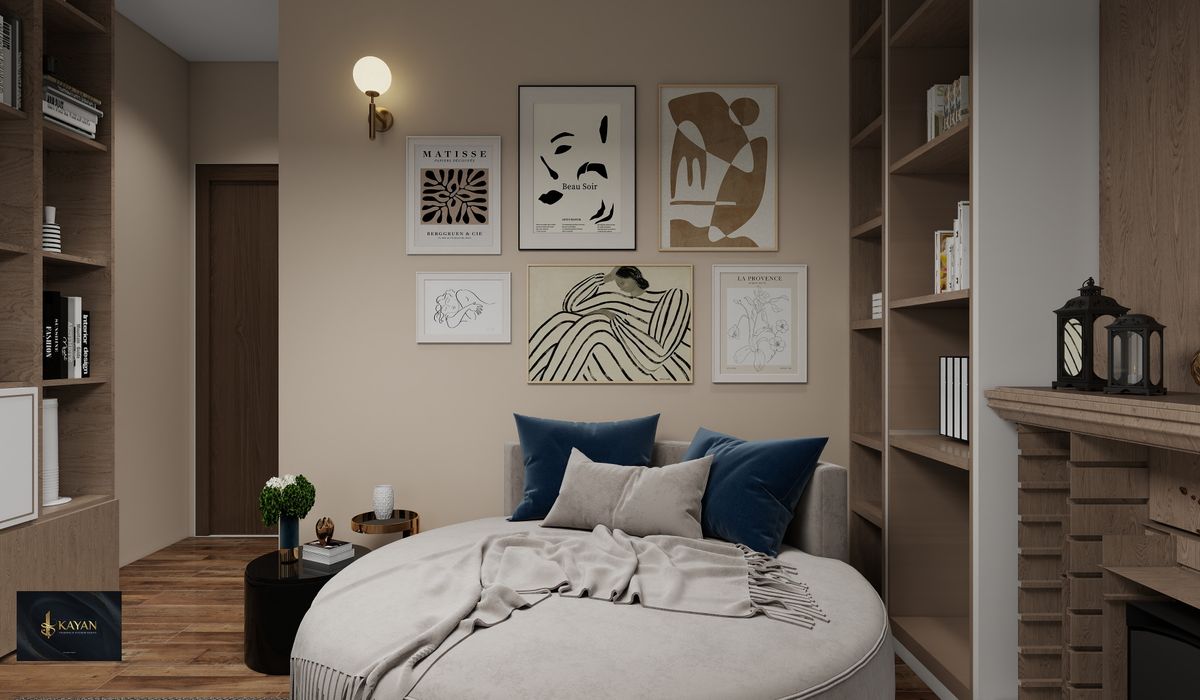
Why soft neutrals suit a British bedroom
Most British bedrooms ask a lot of their decorating. They are often the smallest room in the house, they usually face one direction only — sometimes north, with that cool, flat light that arrives grey from October to March — and they have to hold a bed, a wardrobe and whatever else we can squeeze in without feeling crowded. Soft neutral tones are forgiving in exactly this situation. They bounce what daylight there is around the room and let the shape and texture of the furniture do the talking instead of the colour of the walls.
They are practical, too. A quiet scheme hides the scuff by the door and the faded patch where the sun lands better than a deeper colour, and you can add a vintage find later without repainting everything.
Start with three tones, not one
The common mistake is choosing a single neutral and painting everything in it. The result is flat, and in a small room it can feel oddly institutional. Aim for three tones that sit close together:
- A warm white for the walls — one with a touch of yellow or pink in it rather than a brilliant white, which glares in low light and turns chilly after dark. Look for paint described as chalk, shell or wax.
- Oatmeal as your mid tone, for bedding, a headboard or a pair of curtains. It sits between beige and grey and flatters almost every wood tone.
- A pale grey for the floor, rug or an upholstered chair. Choose one with a hint of green or brown warmth rather than a cool blue-grey, which can look icy against a north-facing wall.
Keep the proportions roughly 60 per cent warm white, 30 per cent oatmeal and 10 per cent darker grey or aged wood for contrast. Always test paint on a large patch of card, or directly onto the wall, and live with it for a few days. Colours shift dramatically between a bright morning and a lamp-lit evening, and a sample pot on a 10cm square tells you very little.
Add depth with texture, not colour
This is where a neutral bedroom either feels calm and considered or simply unfinished. If the palette is quiet, the layers have to carry the interest. Bedding is the easiest place to begin.
- Build the bed in layers: a fitted sheet, a flat sheet if you like the look, then the duvet, then a throw folded across the bottom third.
- Mix weaves deliberately — washed linen against a waffle cotton throw, a ribbed blanket beneath a slubby cushion. Same colour family, different surfaces.
- Choose a duvet cover in oatmeal or a soft off-white and add two or three cushions at most. Any more and you will spend every evening rearranging instead of relaxing.
- Look for second-hand eiderdowns, embroidered linen and crochet throws at charity shops, car boot sales and local auction rooms. Their slight unevenness is exactly what stops a neutral scheme looking like a showroom.
Vintage pieces that keep neutrals from going flat
A room in soft neutrals needs at least one thing with age to it. Patina — the worn edge of a chair, the bloom on old brass, the crazing on a jug — adds warmth that new paint cannot.
Choose one or two pieces rather than a full set. A small dark wood bedside table, a cane or wicker chair in the corner, a faded flatweave rug, a linen drum lampshade on a ceramic base. Anything in aged oak, walnut or worn brass will ground the scheme without shouting. If you want a little contrast, introduce a single dark note: a black iron bed frame, a dark mirror frame, or a pair of plain charcoal linen curtains. One is enough — two starts to feel heavy in a small room.
Small-space tricks that protect the calm
Layout matters as much as colour. Leave 60–70cm of clear floor on the open side of the bed so you can move without turning sideways, and keep the space underneath working — flat lidded boxes in plain linen, or a vintage trunk, rather than a jumble of bags. Keep bedside surfaces to three objects each and put everything else in a drawer.
- Hang curtains as close to the ceiling as you can, with the track extending 15–20cm past each side of the window. The room will read as taller and lighter.
- Use warm white bulbs of around 2700K throughout, and fit a dimmer on the main light if you can.
- Add two small bedside lamps rather than relying on a central pendant alone, so the last thing you see at night is low, warm light.
- Hang a mirror opposite the window to double the daylight, and keep the sill clear.
Finishing touches that hold it together
Once the bones are right, hold back. Store spare bedding in the same neutral family so the room stays quiet when you open a cupboard, and wash linen and cotton at a low temperature so it softens rather than stiffens. A single stem in a simple ceramic vase, a candle, a book on the bedside table — that is usually enough.
The point of a soft neutral bedroom is not that it looks styled. It is that it feels restful at ten o'clock at night when you are tired and the light is low. Choose warm whites and oatmeals, layer your textures, add one piece with a bit of history, and let the room be quiet.






John Doe
14 January, 2022Having no content in post should have adverse..
Chauffina Carr
10 April, 2022We use these tests all time! Killer stuff!
Jim Séchen
16 July, 2022Thanks for all the comments, everyone!